Thought Leadership
Across military simulation and training, AI is enabling more adaptive, data rich environments that are reshaping how armed forces prepare for modern operations.
March 2026, U.S.
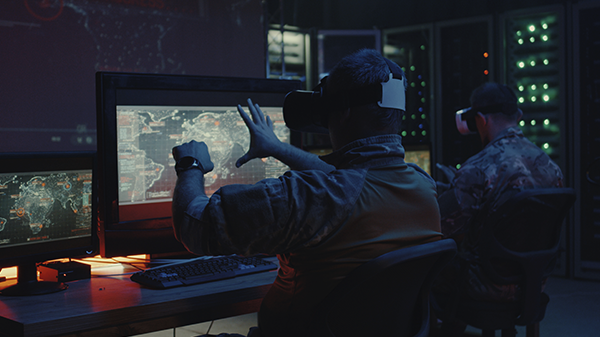
Artificial Intelligence (AI) is rapidly influencing how defence organisations prepare for modern operations. As armed forces confront environments defined by speed, complexity, and multi domain coordination, AI is emerging as a practical tool that strengthens readiness, accelerates decision cycles, and expands what simulated training can achieve. In the modelling, simulation, and training (MS&T) sector, we’re seeing organisations looking for training systems that are more adaptive, data rich, and responsive to emerging threats.
Traditional simulation systems are being complemented by AI-enabled capabilities that enhance realism and reduce manual workload. Three developments are shaping this evolution.
First, adaptive behaviors are making training more ‘real’. Instead of relying solely on pre-scripted actions, virtual entities can respond dynamically via AI to trainee behavior or mission context. At the same time, reinforcement learning agents and behavior modeling techniques allow virtual opponents, civilians, and teammates to learn from repeated simulation runs, producing more varied and challenging scenarios that reflect the unpredictability of real operations.
Second, AI is helping to automate labor-intensive tasks across the training lifecycle. Scenario generation, data interpretation, and after action reporting have traditionally required significant human effort. Natural language processing and generative models now support the creation of scenario variants or mission summaries, reducing administrative burden on instructors and freeing them to focus on coaching and mission context. As simulation content grows more complex, these forms of automation help maintain relevance without increasing manpower.
Third, AI is expanding the role of analytics in decision-making. Force design, experimentation, and operational concept development often depend on processing large volumes of simulation data. AI-enabled tools can compress assessment cycles from weeks to hours, giving planners the ability to test more variations, explore emerging tactics, and refine assumptions quickly. This speed is particularly valuable as militaries rethink how to operate across domains.
As AI models become more sophisticated, they require simulation environments capable of supporting rapid experimentation and integration. Open, modular, and interoperable platforms serve as essential infrastructure. Their architectures allow defence organisations, researchers, and industry partners to integrate reinforcement learning agents, large language models (LLMs), or decision support algorithms without redesigning their entire training ecosystem.
The MAK ONE platform is an example of an open synthetic environment that researchers and defense organizations are using as an AI testbed: a controlled, high fidelity environment where new AI behaviors can be trained, evaluated, and validated safely and repeatedly.
Here are some use cases highlighting how this open platform approach with MAK ONE is accelerating innovation via more adaptive behaviors, greater automation, and faster analytics:
MAK Technologies’ own work on NICO AI — first developed for immersive Marine Corps training — shows how natural language interaction and intelligent virtual role player technologies carry over into constructive simulation to support scenario generation, automated behaviors, and voice driven control within training scenarios.
Across these efforts, interoperability is the through-line. With interoperability, militaries and supporting organizations can adopt AI at their own pace while preserving compatibility with existing systems and data standards.
When used responsibly and built on open, interoperable platforms, AI can speed analysis, deepen realism, and adapt training while preserving the trust, security, and doctrinal alignment modern readiness requires. For MAK Technologies, that means continuing to advance the MAK ONE AI ready platform, helping defense forces learn faster, think smarter, and prepare with confidence for what comes next.
MAK Technologies is a global leader in modeling and simulation software that links, simulates, and visualizes virtual worlds in networked synthetic environments. For over 30 years, MAK has delivered the MAK ONE suite—a proven Commercial-Off-the-Shelf (COTS) simulation software platform—trusted by governments, system integrators, and defense organizations worldwide. Today, we are a mission-driven technology partner, building advanced simulation and training solutions that prepare warfighters for the multi-domain complexity of modern operations.

Len Granowetter,
CTO of MAK Technologies
By subscribing to the mailing list, you confirm that you have read and agree with the Terms of Use and Personal Data Policy.