

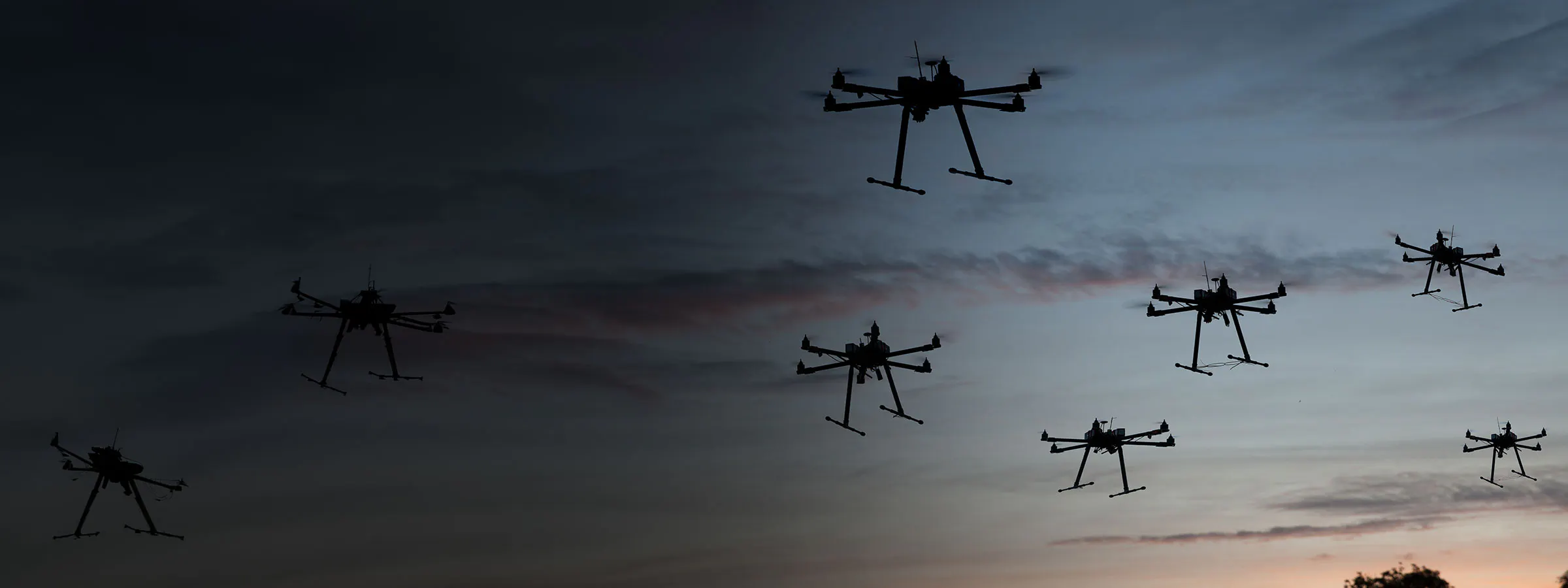
Drone technology is moving beyond remote control as artificial intelligence enables multiple aircraft to work together as a coordinated system. With agentic AI, fleets of drones can respond to changing conditions, adjust their behaviour and coordinate tasks with less reliance on continuous human intervention.
ST Engineering's Hybrid Drone Swarm Intelligent System applies this approach through distributed intelligence across multiple autonomous agents. Instead of relying entirely on a centralised controller, individual drones can make decisions, collaborate with other units and adapt to the environment, creating a scalable and resilient approach to swarm operations.
Traditional drone operations often depend on predefined instructions or direct control. Agentic AI changes this model by allowing each drone to function as an intelligent agent that can assess its situation and respond accordingly. A drone can adjust its flight path, collaborate with other units, and dynamically assume different roles within the swarm.
The system is currently at Technology Readiness Level 3, where agentic AI is being applied to enable drones to coordinate and operate autonomously in real time. This distributed approach allows the swarm to continuously adapt as conditions change instead of relying solely on fixed instructions.
Coordinating multiple drones requires more than simply giving each aircraft a route. Advanced machine learning techniques can support collision avoidance and optimal path planning, allowing drones to navigate crowded or unpredictable environments more safely. When conditions change, the system can respond by adjusting routes and coordinating movement across the swarm.
Learning also plays an important role in improving future operations. Over repeated deployments, the swarm can learn from experience and refine its behaviours. This creates an adaptive system where coordination and performance can improve as the technology is exposed to different operational situations, advancing UAS innovation across various domains.
The architecture behind a swarm directly affects how it responds to disruption and change. A fully centralised approach can place greater dependence on one control point, while a distributed model spreads intelligence across multiple agents. The hybrid architecture combines centralised and decentralised elements to support coordination while reducing dependence on a single point of control.
| Capability | Traditional Centralised Approach | Distributed Swarm Approach |
|---|---|---|
| Decision-making | Decisions rely more heavily on a central controller | Intelligence is distributed across autonomous agents |
| Navigation | Routes may depend on predefined instructions | Drones can dynamically adjust their flight paths |
| Task Allocation | Tasks are primarily assigned through central control | Drones can dynamically assume and redistribute roles |
| Scalability | More units can increase central control complexity | Intelligence is distributed as the swarm expands |
| Resilience | Central disruption can affect the wider system | Remaining drones can continue coordinating after disruption |
| Response Time | Information may need to pass through a central point | Localised decision-making can support faster responses |
As more drones are added, distributed intelligence allows the swarm to scale without concentrating every decision within one central system. This can reduce decision-making latency and support faster coordination, particularly when operating conditions are changing quickly.
Resilience is a key consideration for autonomous swarm operations. If an individual drone is lost or disrupted, the remaining units can autonomously redistribute tasks and adjust their flight paths. This allows the swarm to continue its mission rather than relying on every individual aircraft remaining operational.
This capability also supports dynamic role management. Instead of waiting for continuous instructions from a central controller, remaining drones can adapt their responsibilities based on the situation. The result is a more fault-tolerant system that can maintain coordinated activity despite disruption.
The combination of agentic AI, machine learning and distributed intelligence supports several important capabilities:
These capabilities represent a shift from managing individual aircraft to coordinating an intelligent network of drones. ST Engineering's broader unmanned aircraft work also includes DroNet, an aircraft-agnostic operating platform designed to integrate autonomous and multi-function UAS networks with AI.
The difference between an individual autonomous drone and an intelligent swarm lies in how information and decisions are shared. A single drone can observe its surroundings and respond to local conditions, while a swarm can combine the actions of multiple agents to coordinate a broader mission.
With the hybrid drone swarm intelligent system's agentic AI, a single drone observes, but the swarm understands.
Ang Chee Beng, Head of Precision Systems, ST Engineering
This concept enables coordinated operations across an Area of Operation (AO), with multiple drones able to perform tasks while adapting to changes around them. The system is designed to support complex, coordinated actions upon human confirmation, while eliminating the need for continuous human oversight during the mission.
The value of autonomous drone swarms extends beyond reducing the need for manual control. Their potential comes from the ability to coordinate, adapt, and continue operating as conditions change. For missions conducted in complex environments, this flexibility can be important when fixed instructions or constant central control are less suitable.
ST Engineering's work in autonomous systems reflects a wider focus on applying AI to real-world operational challenges. Its current AI portfolio includes AI for autonomous systems, while its Manned-Unmanned Teaming Operating System is designed to orchestrate unmanned platforms through AI-powered command, control, and communications.
Autonomous drone swarms represent a shift from remotely controlling individual aircraft to orchestrating intelligent, self-coordinating networks. Powered by agentic AI and distributed intelligence, ST Engineering's Hybrid Drone Swarm Intelligent System enables autonomous agents to assess their environment, optimize flight paths, and dynamically redistribute mission tasks even when individual units are lost or disrupted. By combining a fault-tolerant hybrid architecture with human oversight, this technology provides a scalable and resilient foundation for complex operations in unpredictable environments. Contact ST Engineering to learn more about its autonomous drone swarm solutions and how they can support your operational needs.
By subscribing to the mailing list, you confirm that you have read and agree with the Terms of Use and Personal Data Policy.