


As real-time operations generate overwhelming volumes of disconnected data, ST Engineering’s AGIL® Ops Hub—powered by the MRLN.AI® intelligence layer—combines AI-driven operational intelligence, multimodal data fusion, and transparent governance to help enterprise and mission-critical teams move seamlessly from real-time sensing to coordinated action.
For operations teams, the challenge is rarely a lack of information. It is knowing which signals matter, how they connect and what action to take.
Airports, hospitals, utilities, ports, and satellite operation centers all depend on timely, high-stakes decisions. A delay in one domain quickly cascades into service disruptions, safety risks, misallocated resources, and degraded customer experiences. Yet many teams continue to operate across siloed systems, disparate dashboards, and fragmented communication channels.
This is where AI-driven operations deliver practical value: not through automation for its own sake, but by equipping human teams with a clear, unified view of fast-moving situations so they can coordinate and respond with confidence.
Traditional monitoring tools only show what is happening. Next-generation operational intelligence platforms interpret events, identify early indicators of disruption, and drive coordinated responses.
ST Engineering’s AGIL® Ops Hub is an advanced operational intelligence platform built for complex, mission-critical environments. It ingests and contextualises multi-source data streams, delivering a single source of truth through unified dashboards, geospatial visualisation, and integrated workflow engines.
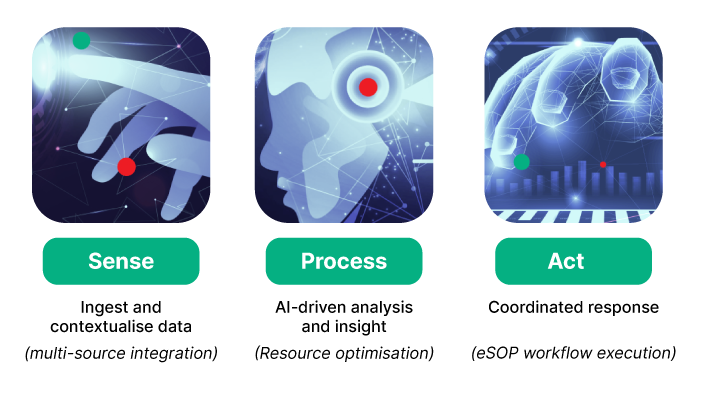
Sense
Real-time ingestion, aggregation, and contextualisation of data across disparate sensors, assets, and enterprise systems.
Process
AI-driven analytics evaluate live operational data to optimize capacity, refine workflows, and allocate resources while keeping human judgment at the center of every decision.
Act
Incident management tools, shared workflows, and electronic Standard Operating Procedures (eSOPs) enable synchronised multi-team responses. Post-event After Action Reviews (AAR) analyse performance to continuously refine future operations.
As enterprise ecosystems become more connected, organizations require AI solutions that are powerful yet explainable, accountable, and strictly aligned with operational rules of engagement.
ST Engineering’s MRLN.AI® serves as a next-generation intelligence layer designed to augment mission-critical environments with agentic, context-aware AI capabilities. It combines advanced reasoning, secure workflows, and real-time data fusion across defense, public safety, emergency response, critical infrastructure, and national security domains.
Multimodal Data Processing
Synthesises text, audio, images, and video feeds in real time using Speech-to-Text, Large Language Models (LLMs), and computer vision.
Interoperable Architecture
Integrates across existing command platforms, sensor networks, and enterprise IT infrastructure.
Transparent & Auditable Governance
Maintains detailed event logs of AI models used, system prompts, operational rules, generated outputs, and human approvals. This ensures complete traceability and verifiable oversight.
Aviation
Airport operations involve airlines, passengers, baggage, ground teams, facilities and service providers. A shared operational view can help stakeholders monitor passenger flow, identify potential bottlenecks and coordinate responses more effectively.
Healthcare
Hospitals manage patient movement, staffing, facilities, equipment and supplies at the same time. By consolidating operational and facility information, AI-assisted platforms can help teams spot emerging congestion or resource constraints earlier.
Utilities
Utilities depend on service continuity across networks, field teams and infrastructure assets. A unified operational view can support earlier detection of incidents, coordinated field response and better post-incident review.
Maritime and ports
Ports bring together vessel movements, cargo activities, equipment, manpower and external stakeholders. Improved situational awareness can help operators coordinate resources and respond more quickly to operational changes.
AI-driven operations are not designed to replace human operators—they are engineered to give teams better tools to manage extreme complexity.
By unifying real-time data, automated workflows, and explainable decision support into a single operational environment, organizations strengthen resilience and maintain clear operational control under pressure. Through AGIL® Ops Hub and MRLN.AI®, ST Engineering delivers a practical, human-centric approach to innovation—moving organizations rapidly from raw information to actionable operational insight.
By subscribing to the mailing list, you confirm that you have read and agree with the Terms of Use and Personal Data Policy.