

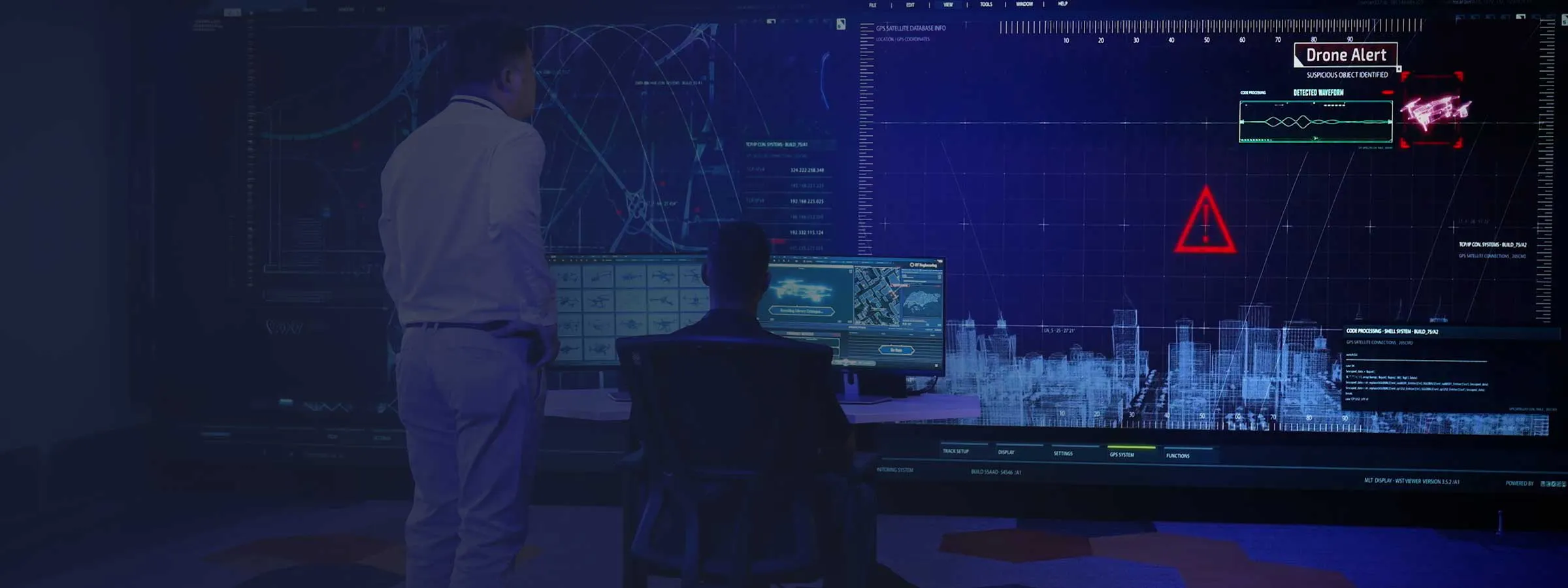
As modern drone threats rapidly evolve, traditional counter-UAS (C-UAS) systems relying on predefined RF signature libraries face critical limitations. ST Engineering’s patented RF Sensor 1000 (S1000) and Intelligent Drone Detection System (IDDS)—integrated into the AGIL® Counter Drone ecosystem—apply AI-powered waveform analysis to identify drone-like signal behaviors in real time, detecting both known and previously unseen threats.
Drone threats are becoming harder to predict. As unmanned aerial systems (UAS) become more affordable, autonomous, and adaptable, organisations responsible for public safety, critical infrastructure, transportation hubs, and national security face increasing pressure to detect and respond to unauthorised drone activity quickly and accurately.
Recent deployments of counter-drone capabilities across defence and critical infrastructure applications underscore the growing need for solutions that can keep pace with rapidly evolving threats.
Today’s challenge goes beyond spotting known threats. Security teams must identify unfamiliar or modified drones whose radio frequency (RF) signals no longer match conventional signature libraries. As drone usage continues to expand across complex environments, detection systems must evolve to evaluate signal behaviors rather than relying strictly on known databases.
To address this shift, ST Engineering has developed advanced AI-powered detection technologies—such as the patented RF Sensor 1000 (S1000) employed within the Intelligent Drone Detection System (IDDS)—that focus on how signals behave, rather than solely whether they match known signatures.
Conventional counter-drone systems typically identify drones by matching detected RF signals against predefined databases of known signatures. While effective against standard off-the-shelf models, this approach faces growing challenges as the threat landscape evolves:
This environment demands adaptive detection approaches that identify drone activity even when signals do not match predefined references.
AI-powered waveform analysis is an advanced C-UAS approach that shifts the fundamental detection question. Traditional systems ask, "Which known drone signature is this?" but AI-powered systems ask, “Does this signal behave like a drone”?”
Using machine learning algorithms, embedded AI engines continuously scan for control and telemetry signals to learn intrinsic signal patterns and analyse waveforms in real time. Because the technology focuses on underlying signal behavior rather than static signatures, it can classify drones operating outside known parameters, including previously unseen or custom-built drone platforms.
The difference between signature matching and AI-powered waveform analysis is central to understanding how counter-UAS capabilities are becoming more adaptive.
| Feature | Traditional Detection Systems | AI-Powered Waveform Analysis |
|---|---|---|
| Detection Method | Signature Matching | AI-Powered analysis of drone-like waveforms |
| Reliance on Libraries | High | Reduced dependence on continual library updates |
| Adaptability | Limited | Stronger adaptability to unfamiliar signals |
| Detection of Unknown Drones | Challenging | Designed to classify both known and unknown threats |
| Responses to Firmware Changes | Often Requires Updates | More resilient to frequency translation and unconventional spectrum usage |
| Scalability | Moderate | Adaptive and scalable within integrated counter-drone operations |
For security operators, the value is not simply better detection. It is faster, more confident decision-making in complex airspace environments where drone-related risks can affect airports, ports, public events, government facilities and critical infrastructure.
Effective counter-drone operations extend far beyond detection. Once a threat is identified, security teams must assess the risk, determine response protocols, and coordinate mitigation measures while maintaining operational continuity. Our AGIL® Counter Drone solution brings together multiple layers of capability within a unified, modular architecture:
By integrating data from multiple sensors into a single C2 environment, operators gain a coherent operational picture, enabling faster, more confident decision-making across airports, ports, government facilities, public events, and critical infrastructure.
“I’m excited that our IDDS, with AI at its core, is directly addressing the growing challenge of identifying unknown drones and the difficulty of neutralising them safely. I believe that with AI, we can build more integrated systems that can autonomously tackle adversary drones,” said Niranjan Gopinath, Engineer, Product Development & Integration.
Behavior-Based Sensing: AI-powered waveform analysis replaces static library dependency by analyzing intrinsic RF signal characteristics in real time.
Resilience to Unknowns: Technologies like the patented RF Sensor 1000 (S1000) and Intelligent Drone Detection System (IDDS) detect modified, updated, or non-cataloged drone threats.
Integrated Defence: Embedded within ST Engineering’s AGIL® Counter Drone framework, AI waveform analysis feeds into a unified Detect-Decide-Disrupt-Defeat workflow for comprehensive airspace security.
By subscribing to the mailing list, you confirm that you have read and agree with the Terms of Use and Personal Data Policy.