

Simulation training plays a vital role in preparing teams for complex and high-pressure environments. However, traditional approaches often demand significant time, manpower, and coordination. As training needs grow, these limitations can slow progress and make it harder to deliver consistent outcomes.
Advancements in artificial intelligence are changing this landscape. By integrating intelligent systems into simulation environments, training programs can now become faster, more scalable, and far more responsive to real-world conditions.
Traditional simulation setups often require multiple support personnel for a single trainee session. In many cases, up to four individuals are needed to manage operations, observe performance, and role-play scenario dynamics. This creates severe resource constraints, especially when organizations need to scale training across larger groups.
Consistency is another concern. Training quality can vary significantly depending on the experience and style of individual instructors. As a result, learners may receive different levels of guidance, affecting overall performance outcomes and operational flexibility.”?”
Artificial intelligence introduces automation and adaptability directly into simulation environments. By applying generative AI for scenario creation and agentic AI for system orchestration, modern platforms—such as the AGIL® Co-Trainer developed by ST Engineering Digital Systems—can execute and refine exercises with minimal manual input, maintaining high realism while easing the burden on staff.
AGIL Co-Trainer significantly streamlines operational procedures, allowing practitioners to focus on higher value tasks while maintaining rigorous training standards.
Lester Chan Wei Jian, Assistant Manager, ST Engineering Training & Simulation Systems
One key advantage is speed. Instructors can generate complex training environments using simple text or voice commands, adjusting scenarios in minutes rather than hours.
| Aspect | Traditional Training | AI-Powered Training |
|---|---|---|
| Scenario Creation | Manual and time-consuming | Automated and rapid |
| Resource Requirement | High manpower needed | Reduced human dependency |
| Scalability | Limited sessions | Supports multiple learners |
| Consistency | Instructor-dependent | Standardized processes |
| Feedback | Delayed and subjective | Real-time and data-driven |
This comparison highlights the clear advantages of adopting AI in simulation training environments.
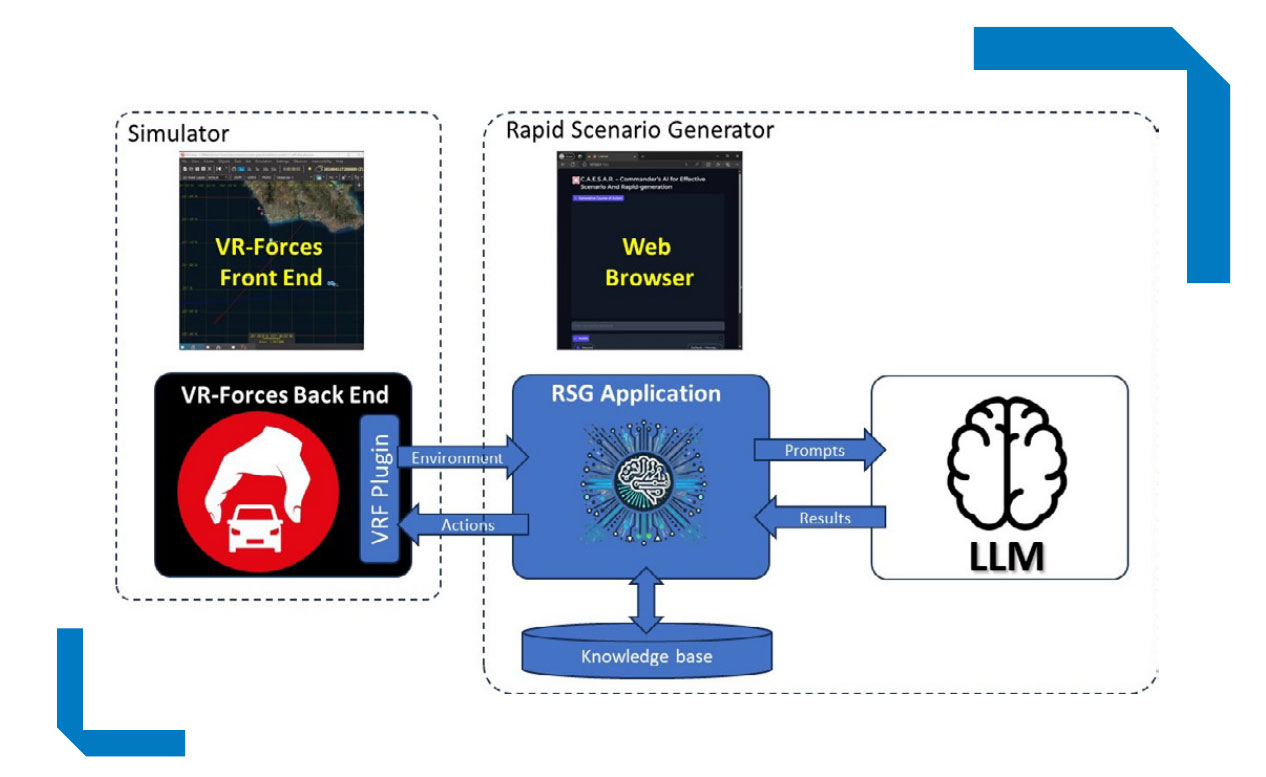
At the core of AI-driven simulation training is the Rapid Scenario Generator (RSG). This system converts natural language inputs into realistic, executable training scenarios. Instructors simply define their objectives and operational context, and the system handles the setup.
RSG draws on both proprietary and open-source data to anticipate and simulate interactions between friendly and opposing forces. Through iterative natural language refinement, scenarios can be adjusted quickly to ensure they remain aligned with evolving training goals.
By turning natural language into complex, AI-driven scenarios in minutes, we are empowering instructors to achieve more with fewer resources—redefining training for an era where efficiency and resilience matter most.
Koh Meng Hui, Engineer, Technology Office, ST Engineering Training & Simulation Systems
These features allow organizations to scale training programs without compromising quality.
To enhance tactical realism, simulation systems integrate advanced Computer-Generated Forces (CGF) engines, such as MAK VR-Forces. This enables autonomous virtual teammates and opponents that react dynamically during exercises.
The RSG acts as a virtual commander, orchestrating how these adaptive forces interact within the environment. Their responses adjust in real time based on learner actions, creating an immersive experience that mirrors real-world situations.
Virtual teammates bring a new level of interaction to exercises. Powered by in-house voice-to-text technologies, they can:
By reducing reliance on human role-players, organizations can conduct concurrent sessions for multiple learners, lowering operational costs while maintaining active participation.
Performance tracking is essential for effective learning. AI-powered systems capture detailed data from every session, producing an objective, clear record of learner interactions and behavioral patterns.
When combined with analytical platforms such as the Mission Analytics and Review System (MARS), this data yields measurable performance indicators for more precise evaluations. Integrating wearable tech inputs further enhances this analysis, offering a holistic, evidence-based view of overall readiness.
AI streamlines the entire training process, from scenario design to evaluation. Instructors can focus more on guiding learners rather than managing technical details. This shift improves both productivity and the overall training experience.
Standardization is another key benefit. Automated systems ensure that each training session follows consistent parameters, reducing variability and improving reliability across programs.
AI-powered simulation training is highly versatile. Today, solutions like AGIL® Co-Trainer are embedded as standard features across simulator platforms for air, land, and maritime (sea) operations. This flexible integration ensures organizations can adopt advanced solutions without disrupting existing training pipelines or training dashboard workflows.
AI is reshaping simulation training by making it faster, more scalable, and more adaptive. With tools like the AGIL Co-Trainer developed by ST Engineering, organizations can streamline training workflows while maintaining high standards of realism and accuracy.
As training demands continue to evolve, adopting AI-driven solutions will help organizations stay prepared, efficient, and ready to handle complex operational challenges.
By subscribing to the mailing list, you confirm that you have read and agree with the Terms of Use and Personal Data Policy.